
Semaglutide tablet: use, dosage, side effects and cost in Finland
Key points
- The semaglutide tablet is a once-daily medicine taken by mouth to treat type 2 diabetes.
- The tablet is taken on an empty stomach with a small amount of water, and you must wait at least 30 minutes before eating.
- Treatment starts with a low dose that is increased gradually as your doctor instructs. The dosage depends on the product used.
- The most common side effects are stomach symptoms such as nausea, and they tend to occur at the start of treatment and when the dose is increased.
- The semaglutide tablet is a prescription medicine; the price and your own share of the cost depend on the product, pack size and reimbursement.
The semaglutide tablet is a prescription medicine used to treat type 2 diabetes in adults, alongside diet and exercise.
The product attracts particular interest because it is semaglutide taken by mouth. Many people find it an easier option than an injected medicine, but at the same time the correct way of taking it becomes more important. The tablet is not an ordinary diabetes medicine in the sense that its absorption depends a great deal on when and how it is taken. That is why it is worth knowing the instructions well from the very start.
If you have been prescribed this medicine, the most important thing is to use it exactly as your doctor has instructed. This text covers what the product is intended for, what the most common side effects of the semaglutide tablet are, and when symptoms or side effects are a reason to contact a healthcare provider.
What is the semaglutide tablet?
The semaglutide tablet contains semaglutide as its active substance. Semaglutide belongs to the GLP-1 receptor agonists, a group of medicines that affect blood sugar regulation in several ways. It increases glucose-dependent insulin secretion, reduces glucagon secretion when needed and slows the emptying of the stomach. In practice this can help control blood sugar after meals, and in some people it also helps control appetite.
The tablet treatment discussed here is intended for adults who have type 2 diabetes and whose blood sugar balance is not adequate with lifestyle treatment or other medication alone. It can be started on its own when metformin is not suitable, or it can be used together with other diabetes medicines. The semaglutide tablet is not intended for the treatment of type 1 diabetes.
Many people wonder whether the product is the same as other semaglutide products. The active substance is the same as in some injectable products, but the dosage form, absorption, dosing and experience of use are different. This is exactly why the instructions for this tablet differ from those for ordinary tablet medicines.
The benefit of the medicine is always assessed as part of the overall treatment of diabetes. Medication does not replace diet, exercise, sleep or other treatment that needs to be followed up; it complements them. The aim of treatment is not only to improve an individual blood sugar reading, but to manage the overall risk over the long term.
In the treatment of type 2 diabetes
The semaglutide tablet is one of the current treatment options for type 2 diabetes, which are used according to each person's situation. Not everyone starts the same medication in the same way; the choice is influenced by factors such as blood sugar level, other medication, heart and kidney disease, the need for weight management and how well the medicine fits into everyday life.
In type 2 diabetes the first-line starting medicine is often metformin, but it does not suit everyone because of stomach problems, contraindications or other reasons. In that case the doctor can consider another option. In some situations a medicine from the GLP-1 group may also be considered alongside other medication, especially when the overall aim is good glucose balance without a high risk of hypoglycaemia.
Semaglutide does not cure diabetes, but it can make it easier to reach treatment balance. The response to treatment is usually assessed on the basis of blood sugar monitoring, long-term blood sugar (the HbA1c value), any side effects and how smoothly the treatment works in practice. If the medicine causes a lot of side effects or its effect is insufficient, the treatment can be changed.
From the patient's point of view, an important question is often what can realistically be expected from the medicine. The aim is usually better blood sugar control and, for some, also a mild or moderate fall in weight. The response is not the same for everyone, however. That is why the experiences of semaglutide tablets you see online do not reliably tell you how the medicine will suit you.
The semaglutide tablet taken by mouth
The tablet form is the most important special feature of this semaglutide product. In Finland many people know semaglutide specifically from injectable products, but it is also available as an option taken by mouth. This may seem easy, but at the same time the absorption of the medicine is more sensitive to mistakes in use than with many other tablets.
The tablet is swallowed whole with a small amount of water. The tablet should not be split, crushed or chewed, because it is then not known whether the absorption of the medicine changes. In addition, the tablet must be taken on an empty stomach, and afterwards you must wait before eating, drinking or taking other medicines by mouth.
In everyday life this usually means that the tablet is taken straight after waking up. Many people find this the easiest way, because after the night the fast is already long enough. For others, another fixed time works better, as long as there is a fast of at least eight hours before the dose and the wait of at least 30 minutes after the dose is remembered every day.
Because absorption happens in an unusual way, precision in use is part of the treatment's success. If the response to the medicine is weaker than expected, the reason can sometimes be that the tablet was taken with too much water, with food or coffee too soon, or at the same time as several other morning medicines.
Using the semaglutide tablet in practice
Starting treatment usually goes best when the routine is simple. The tablet is taken on an empty stomach, preferably after an overnight fast. It is swallowed whole with no more than about 120 millilitres of water. After that, wait at least 30 minutes before eating, drinking and taking other medicines by mouth.
If you forget a dose, the missed tablet is not made up later the same day; the next dose is taken at the usual time the following day. Do not take two tablets at once to make up for a forgotten dose. If you are unsure about your own instructions, always check them in your own package leaflet or with your treating doctor.
Small practical measures help the treatment succeed:
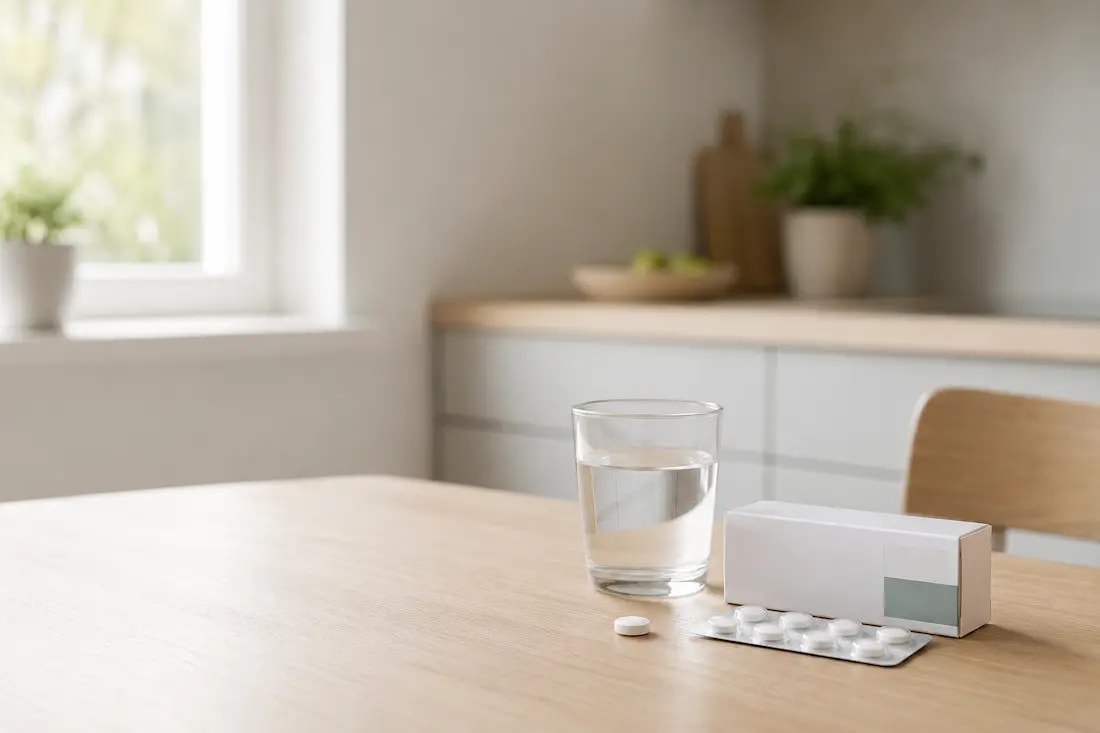
- keep the blister pack and a glass of water ready in a place where you will remember the medicine in the morning
- avoid having coffee, juice or a large amount of water at the same time as the tablet
- take your other morning medicines by mouth only after at least 30 minutes, unless your doctor has instructed otherwise
Side effects and adverse effects
The side effects of the semaglutide tablet most commonly involve the digestive tract. Nausea, diarrhoea, abdominal pain, vomiting, constipation, bloating, belching or heartburn-like symptoms are possible, especially at the start of treatment and when the dose is increased. The symptoms are often temporary, but they can also make everyday life clearly more difficult.
In some people blood sugar can fall too low if the medicine is used together with, for example, insulin or a sulfonylurea. In that case the doctor may need to change the other medication. The product on its own does not usually cause a significant risk of hypoglycaemia, but in combination treatment the situation can be different.
The semaglutide tablet and weight management
Semaglutide is also known as a substance that affects weight. It is important, however, to distinguish between the medicine's official indication and a possible additional benefit. The tablet product discussed here is intended for treating type 2 diabetes in adults, not primarily as a weight-loss medicine.
Weight may fall during use, but the effect is not the same for everyone. For some there is no great change in weight; for others weight falls gradually, especially when appetite decreases and eating becomes more regular. That is why the question of whether the medicine can affect weight is a reasonable one, but there is no answer that fits everyone.
If a person is considering medication specifically for the treatment of obesity, the medicine is chosen on different grounds than in the treatment of type 2 diabetes. In this situation it is important to talk to a doctor openly about the goal. A wish to lose weight alone does not mean that this particular product would be the right option.
For weight management it is also important that the medication does not carry the load alone. Meal rhythm, enough protein, fibre intake, sleep, exercise and the rest of your life situation all affect whether a possible benefit shows in practice. If eating becomes too difficult because of nausea, the result may be feeling unwell rather than a controlled change in weight.
Semaglutide as a tablet or an injection?
In both, the active substance is semaglutide. The difference is not only in the dosage form, however, but also in the way it is used and in absorption. Injectable semaglutide is given under the skin, whereas the semaglutide tablet is taken by mouth.
The doctor assesses the whole picture. For some people the tablet form fits everyday life better; for others the injection form may be more practical or more appropriate in terms of effect. Side effects, treatment goals, availability and fitting it together with other medication also play a part.
The most essential differences for comparison can be summarised as follows:
| Point | Semaglutide tablet | Injectable semaglutide |
|---|---|---|
| Dosage form | Tablet taken by mouth | Injected medicine |
| Active substance | Semaglutide | Semaglutide |
| Dosing rhythm | Once a day | Once a week |
| Everyday consideration | Empty stomach, a little water, a 30-minute wait | Injection instructions and remembering the injection day |
| Suitable for | People for whom the tablet form fits well into everyday life | People for whom the injection form is a workable option |
When to see a doctor during treatment?
A doctor's assessment is appropriate if the medicine does not seem to suit you, your blood sugar stays high, side effects drag on or you become unsure about the dosage. It is also worth getting in touch if the everyday routine does not work: for example, if you keep forgetting the waiting times or your other morning medicines do not fit the rhythm.
Seek care more urgently if you have severe and persistent abdominal pain, clear dehydration, unusual weakness, a change in your level of consciousness, repeated hypoglycaemia or a sudden deterioration in vision. Although such situations are rarer than ordinary nausea, it is good to recognise them.
It is also sensible to get in touch if you repeatedly eat very little or if your weight drops quickly without a plan. Then it needs to be assessed whether this is a desired effect or whether the treatment is putting too much strain on the body in relation to its benefit.
Nor is the product a good medicine to try on your own without a diagnosis or a doctor's follow-up. If there is no confirmed type 2 diabetes behind it, or if the main goal is weight loss, the safe way is to start the conversation with a healthcare provider rather than on online discussion forums.
Official product information
Every product containing semaglutide has two official documents. The package leaflet is the instruction written for the user, and it comes with the medicine pack. The summary of product characteristics is a more detailed description for healthcare professionals of the product's use, dosage, contraindications and side effects.
Both documents are in the medicine search of Fimea, the Finnish Medicines Agency: products containing semaglutide in the Fimea medicine search. Choose the product you use from the list to see its package leaflet and summary of product characteristics. They are the most up-to-date and reliable source of information, and are worth reading before treatment starts.

Need a doctor?
Describe your symptoms in a remote appointment — a doctor assesses your situation 24/7.