

Impetigo: Symptoms and Treatment
Key points
- Impetigo is a superficial bacterial skin infection that is most common in children but spreads just as readily to adults through a gym, a family member or a skin break of their own.
- It begins as a red patch and develops into blisters or a honey-coloured crust without fever or other general symptoms.
- Mild, localised impetigo usually clears with home care: soaking off the crusts and applying an over-the-counter antimicrobial ointment.
- A doctor's assessment is needed if the rash spreads, home treatment is not working, or impetigo is suspected in a newborn or young infant.
- Good hand hygiene, covering the affected area and washing shared towels, pillowcases and toys are the most effective ways to stop it spreading.
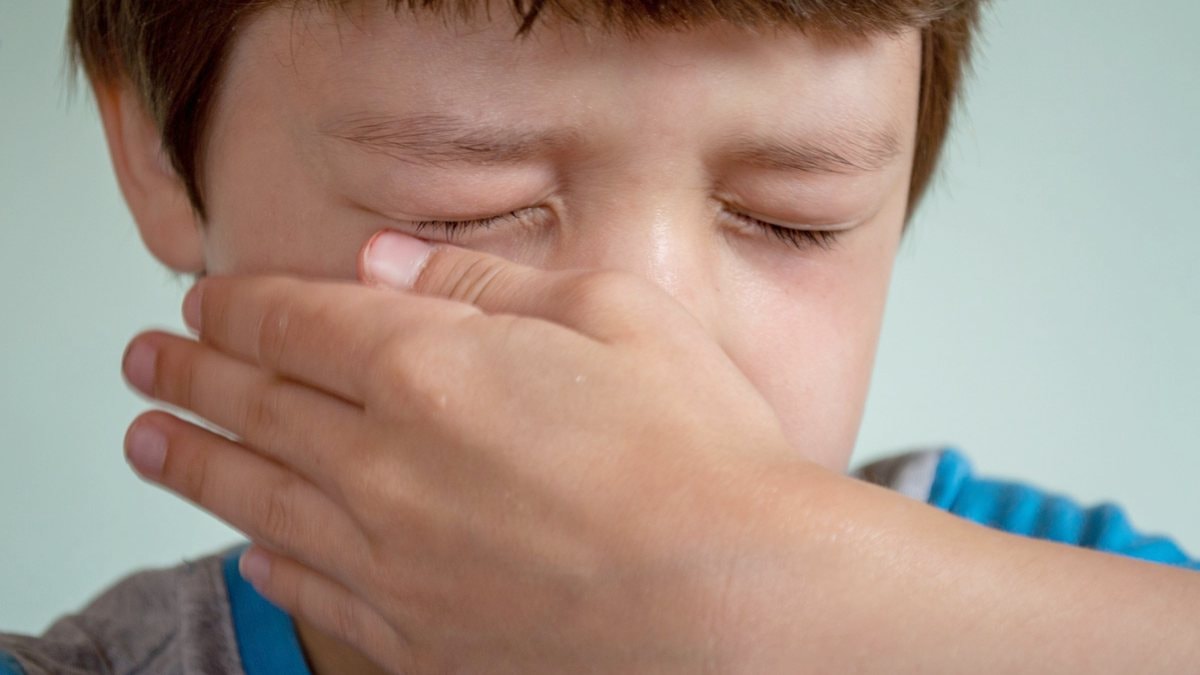
Impetigo is a superficial bacterial skin infection that often starts as a small area of redness and turns, within a day or two, into blisters or a honey-coloured crust. It is best known as a childhood skin condition, but it affects adults just as readily whenever bacteria find a way in through a small cut, insect bite or patch of irritated skin. Most cases clear up with straightforward home care, though some situations call for a doctor's assessment and a course of antibiotics. This article explains what causes impetigo, what it looks like at each stage, how it spreads, how it is treated at home and by a doctor, and when it is worth seeking care.
What Is Impetigo?
Impetigo is an infection of the outermost layer of skin, caused most often by Staphylococcus aureus, group A Streptococcus (Streptococcus pyogenes), or both bacteria together. They enter through a minor break in the skin, such as a scratch, an insect bite, a patch of eczema or any other small wound, and trigger a local infection that shows up on the surface as redness, blisters and, later, a crust. Unlike many other skin infections, it usually stays confined to the surface layer and does not typically cause fever or a general feeling of illness, which is part of why it is generally considered mild despite spreading so easily between people.
There are two recognised forms: non-bullous and bullous. The non-bullous form is far more common and moves quickly from small blisters to a crusted patch, while the bullous form produces larger, fluid-filled blisters that take longer to burst. Neither form usually requires laboratory testing to confirm, because the appearance is distinctive enough for a doctor to recognise on sight in most cases.
What Causes Impetigo in Adults and Children?
Childhood impetigo is by far the most common presentation, largely because young skin is thinner and children are in close, constant contact with one another. The bacteria spread easily through hands, shared toys and everyday contact at nursery, school and home, and even a tiny break in the skin is enough to give the infection a foothold. Impetigo in adults tends to follow a similar pattern but in different settings. Transmission can come from shared equipment and surfaces at a gym, close contact with an infected child or family member, or through the adult's own skin break, such as an insect bite, eczema flare or small wound.
What causes impetigo to take hold in any given person usually comes down to the condition of the skin and the surrounding environment: the more small breaks or dry, irritated patches someone has, the more easily the bacteria can establish themselves. Eczema and other ongoing skin irritation raise the risk in both children and adults, since the skin's natural barrier is already weaker in those areas. Crowded environments such as barracks, sports teams or shared households can also see infections spread quickly if towels or equipment are shared carelessly.
Early Stage Impetigo: What Are the First Signs?
Early stage impetigo usually appears as a small, red, mildly tender patch that can easily be mistaken at first for ordinary skin irritation or an insect bite. In children of nursery and school age, the corners of the mouth and the area around the nostrils are typical starting points, along with the limbs on occasion, while in newborns and small infants it tends to appear first in skin folds, such as the neck, armpits or groin. Mild impetigo often stays limited to a patch only a few centimetres across, whereas an untreated infection can spread further and appear on new areas of skin through contact. Impetigo on the face is an especially common location, since facial skin is thin and frequently touched by hands, towels and pillowcases.
The symptoms move along fairly quickly: small pus-filled blisters appear first and turn, within a couple of days, into a honey-coloured crust — the stage most people recognise from an impetigo rash photo shown for comparison by a doctor or pharmacist. Roughly seven in ten cases are the non-bullous form, where the blisters are small and crust over rapidly, while in bullous impetigo the blister can grow to a couple of centimetres before it bursts, leaving behind a clear, moist wound surface. Itching is common in both forms, but fever, significant pain or a general decline in wellbeing are not typical; if those appear, it is worth having the situation checked, since a deeper skin infection could be involved instead.
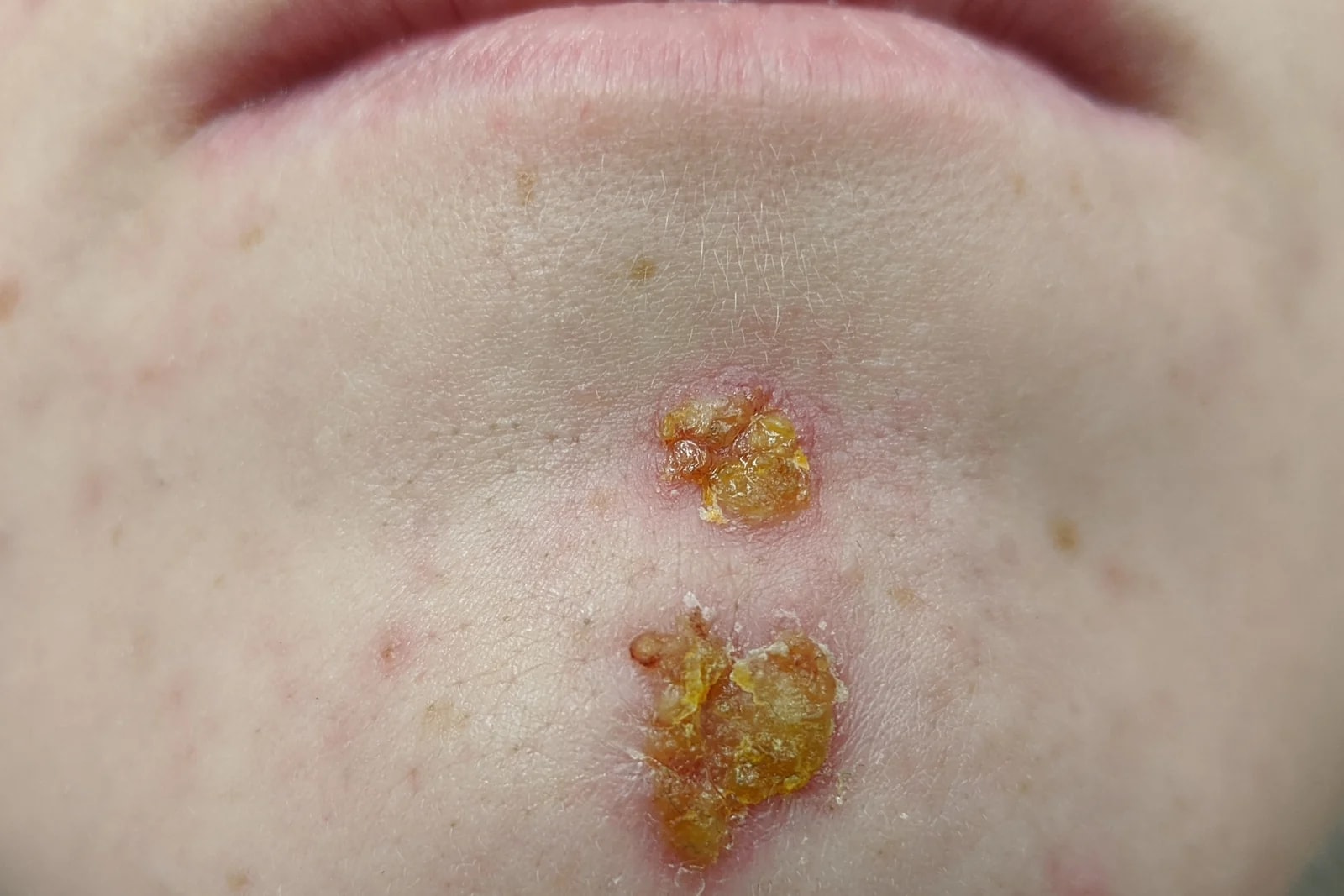
The rash on the face is sometimes confused with cold sores, since both can appear around the mouth. The difference is that a cold sore usually begins with a burning or tingling sensation and a tight cluster of small blisters, whereas the bacterial rash spreads into a broader, honey-coloured crust fairly quickly and does not typically burn in the same way.
Bullous vs Non-Bullous Impetigo
The distinction between the two forms matters mainly because it affects how the rash looks and, occasionally, how quickly it needs attention. Non-bullous impetigo, the more common type, begins as tiny blisters that break almost immediately and dry into the familiar golden crust, and it tends to stay fairly localised around the nose, mouth or a limb. Bullous impetigo instead produces larger, more clearly fluid-filled blisters, caused by a toxin produced by certain strains of Staphylococcus aureus, and these blisters can persist for a day or two before rupturing and leaving a thin, shiny wound bed behind.
Bullous impetigo is somewhat more likely to appear on the trunk, in skin folds or in infants, and because the blisters are larger and more fragile, the affected skin can look more dramatic than the non-bullous form even though the underlying infection is treated the same way. Neither form is inherently more dangerous than the other in an otherwise healthy person, but a rapidly spreading bullous rash in a newborn is one of the situations where prompt medical review matters most.
Impetigo in Infants and Young Children
In newborns and small infants, the infection most often appears in skin folds, such as the neck, armpits or the nappy area, where skin stays in near-constant contact with moisture and friction. Impetigo in infants can spread unusually quickly, because a newborn's skin is still thin and the immune system is still maturing, which is why even a small skin change is worth showing to a doctor rather than waiting to see how it develops at home. During nappy changes, it helps to avoid rubbing or wrapping the affected area too tightly, since friction can irritate the skin further and slow healing.
In older toddlers and young children, the pattern is similar to what is seen in adults, but it tends to spread faster because children touch their faces and other areas of skin far more often, and mostly without noticing. Parents can help by gently discouraging scratching of an itchy patch and reinforcing handwashing before meals, which reduces the chance that the infection spreads to new areas of the child's own skin or to siblings.
Is Impetigo Contagious? How It Spreads
Impetigo is highly contagious, and transmission happens primarily through direct skin contact with an infected area, though it also spreads indirectly through shared towels, pillowcases, toys, razors and other everyday items. Fluid from a blister or open sore carries large numbers of bacteria, and only a small amount is needed to start a new infection on another part of the same person's skin or on someone else entirely. The bacteria can survive on surfaces, fabrics and toys for several hours, and longer still in favourable conditions, which is one reason washing shared items is a genuinely useful part of treatment.
The incubation period, meaning the time between exposure and the first visible signs, is typically around two to five days, though this varies from person to person. The risk of passing the infection on is highest while blisters or sores remain open and uncovered, and it drops off quickly once treatment has started and the area has dried out or been covered. Within families, nursery groups or close social circles, transmission is common precisely because contact is frequent and hands touch both one's own skin and other people's. Scratching an itchy patch and then touching another part of the body is a typical way a single person spreads the infection to new areas on themselves.
How to Ease Impetigo Symptoms at Home
Most mild, localised cases clear up with home care alone, without needing to see a doctor. Crusts should be soaked off gently in a bath or with a warm, damp cloth, since bacteria can survive underneath a crust and slow healing if it is left undisturbed. After soaking and careful drying, an over-the-counter antimicrobial ointment is applied to the area twice a day, usually for about a week or for as long as it is clearly working. Scratching should be avoided, since it spreads bacteria to new areas of skin and prolongs healing, and keeping nails short and clean is particularly helpful for young children.
Alongside home treatment, it helps to keep the affected area away from contact with other family members' skin: personal towels, frequent handwashing with soap, washing pillowcases and toys, and swapping toothbrushes or sponges all reduce the chance of the infection spreading further or reaching someone else. A light, breathable dressing can protect the area during the day, provided it is changed regularly and does not keep the skin constantly damp. If home care does not seem to be working after a few days, or if the area is clearly spreading despite soaking and ointment, it is worth having it checked by a doctor rather than continuing indefinitely on your own.
When Does Impetigo Need a Doctor's Assessment?
Most cases can be managed and monitored at home as long as the area stays small and improves steadily with soaking and ointment. It is worth contacting a doctor if the rash spreads beyond roughly six square centimetres, if home treatment clearly is not working after a few days, or if patches appear in several different areas of the body, or on the scalp or in a beard, since ointment alone is usually not enough in those situations.
Urgent review is needed if the skin around the affected area develops clearly spreading redness, warmth or swelling, if fever or a general decline in wellbeing accompanies the rash, or if impetigo is suspected in a newborn or very young infant — in a baby, the situation is always worth checking with a doctor without delay, since the infection can spread and affect overall wellbeing faster than in an older child or adult. A patch that is unusually painful, spreading rapidly or simply does not look typical is always a reasonable reason to seek an assessment regardless of age, since similar symptoms can occasionally point to a deeper skin infection that needs a different kind of treatment than ordinary impetigo.
Impetigo Treatment: What a Doctor Does
Treatment follows the same principles regardless of age: soaking first, then an antimicrobial ointment, and an oral antibiotic if that is not enough. A doctor usually diagnoses impetigo on sight, because the appearance — a red patch, blisters and a yellow crust — is generally distinctive enough that no separate tests are needed. In less clear-cut situations, or if standard treatment is not working, a doctor may take a swab from the affected area to guide treatment more precisely. For a small, localised patch, treatment is often the same as at home: an antimicrobial ointment together with careful soaking of the crusts, though a doctor may prescribe a stronger topical antibiotic on a prescription basis, such as fusidic acid or mupirocin, if an over-the-counter ointment has not been enough.
For a more widespread infection, or one that has appeared in several places, an oral antibiotic course is usually added, typically lasting around seven to ten days. The choice of antibiotic can depend on whether the swab shows Staphylococcus, Streptococcus, or both. If impetigo keeps coming back, the cause is often bacteria that persist in the nostrils and spread again, for example through nose-picking; in that case, a doctor may recommend a short course of antiseptic or antibiotic nasal ointment, sometimes for other family members too, to break the cycle.
What to Watch for During Recovery
A good sign that treatment is working is that the redness starts to fade and no new blisters appear after a few days of care. If the area keeps spreading instead, the itching gets worse, or clear swelling develops around the skin despite treatment, it is worth contacting a doctor again, since the treatment may need to be changed or stepped up. In children, it is also worth watching general wellbeing: tiredness, poor appetite or fever are not part of the typical picture, and if they appear, it is a reason to seek an assessment regardless of how the skin itself looks.
After healing, the skin can be left temporarily lighter or darker for a while, which usually evens out on its own over the following weeks without any specific treatment. To help prevent a recurrence, it is worth keeping up good hand hygiene and regularly washing towels even after the rash has cleared, since the bacteria can persist in places like the nostrils for longer without causing any visible symptoms.
Who Is More Likely to Get Impetigo?
Individual susceptibility varies, but a few factors show up repeatedly in cases that prove harder to settle. Ongoing skin conditions such as eczema weaken the skin's natural barrier and give the bacteria an easier route in, which is one reason keeping eczema well managed matters even when there is no active infection to see. In close-contact settings such as nurseries, team sports and shared housing, infections spread faster simply because there is more skin contact and more shared surfaces than in everyday life otherwise. Warm, humid weather increases sweating and minor skin friction, which partly explains why cases are seen more often over summer.
How quickly small skin breaks are dealt with also affects the risk: cleaning and covering a wound, insect bite or scratch as soon as it appears reduces the chance that bacteria get a foothold there. In a household where someone is already affected, paying extra attention to handwashing and keeping personal items separate for a short period is the single most effective way to break the chain of transmission at home.
How Can Dokport Help with Impetigo?
If a skin change is worrying you, or you are not sure whether it is impetigo or something else, Dokport lets you speak with a doctor remotely without a traditional appointment. A doctor can assess the symptoms in a chat, often using a photo, and give personalised guidance on whether home care is enough or whether prescription treatment is needed. Depending on the situation, the doctor may prescribe topical or oral antibiotic treatment where appropriate, and can direct you or your child to further tests or an in-person appointment if the symptoms need a closer look than can be managed remotely. A medical certificate for time off work can also be issued if working or childcare capacity is temporarily affected. The aim is to offer fast, easy and safe access to a doctor's assessment whenever a skin change is causing concern or home care does not feel like enough.
Preventing Impetigo
Because the infection spreads mainly through contact, the most effective way to prevent it is avoiding contact with an affected area and keeping up good hand hygiene, particularly washing with soap before eating and after touching your own or someone else's skin. Covering an affected area with a plaster or dressing meaningfully reduces the risk of passing it on, and using personal towels, pillowcases and soft toys, along with washing them regularly, cuts the risk for both the affected person and other family members. Managing eczema or any other ongoing skin irritation well indirectly helps prevent impetigo, since intact skin is a much harder route for the bacteria than skin that is constantly irritated or broken.
Returning to nursery, school or work is generally fine once topical treatment has been under way for around 48 hours, or an oral antibiotic course for around 24 hours, and the area is clearly settling down. If impetigo keeps recurring within a household, it is worth considering whether shared habits or objects are keeping the infection going, and discussing with a doctor whether a short course of antiseptic nasal treatment might be worthwhile for the whole family. Regularly cleaning shared sports equipment and other shared surfaces is also worth adopting as a habit if infections have occurred more than once within a team or group.
Summary
Impetigo is a common, usually mild but highly contagious bacterial skin infection best known as a childhood condition, though it spreads just as readily to adults through a gym, a family member or a small skin break of their own. Its early stage shows up as a red, blistered or crusted patch that develops without fever but often with itching, and most cases clear up with careful soaking and an over-the-counter ointment within a couple of weeks. A doctor's assessment is worth seeking if the area spreads, home treatment is not working, or impetigo is suspected in an infant, since these situations often call for prescription treatment and closer follow-up. Good hand hygiene, covering the affected area and washing shared items are the most effective ways to stop the infection spreading, both to yourself and to those around you.

Need a doctor?
Describe your symptoms in a remote appointment — a doctor assesses your situation 24/7.
Frequently asked questions
What usually causes impetigo?
Is impetigo dangerous?
Can impetigo be treated at home?
How long does impetigo last?
Is impetigo contagious?
What is the incubation period for impetigo?
Does impetigo always need antibiotics?
Does a painkiller help with impetigo?
Can you go to work or nursery with impetigo?
Can a remote doctor help with impetigo?
When could it be something more serious than impetigo?
Does impetigo come back easily?
Can impetigo be prevented?
What does early stage impetigo look like?
Is impetigo the same as a cold sore?
Can adults get impetigo even though it is most common in children?
Can impetigo leave scars?
What is the difference between bullous and non-bullous impetigo?
Read also
- Hand, Foot and Mouth Disease in Adults: Symptoms, Contagion and When to See a Doctor
- Hand, Foot and Mouth Disease at Daycare: Keeping It From Spreading This Autumn
- Acne: symptoms, causes, treatment options, and when to get help
- Atopic Dermatitis
- Cellulitis: Symptoms, Causes, and Treatment
- Fungal infection: symptoms, treatment, and when to seek care